Onboarding Success: Key Strategies for a Smooth Transition

Ensure Your New Senior Executive’s Onboarding Success: Key Strategies for a Smooth Transition

Bringing a new senior executive into your organisation is a critical moment that can significantly impact your business’s success. Effective onboarding is essential—not just for the new leader, but also for the team they will manage and the wider organisation. Here’s how you can ensure a smooth and successful onboarding process for your new senior executive.

1. Start Before Day One: Pre-Onboarding Essentials

The onboarding process should begin well before the executive’s first day. Provide them with key materials, such as the company’s strategic plan, financial reports, organisational charts, and any other relevant documents. Arrange meetings with key stakeholders, including the board, direct reports, and other members of the senior leadership team. This early engagement helps the new executive start building relationships and understanding the company’s culture and dynamics before they officially begin.

2. Clarify Roles, Responsibilities, and Expectations

For any new executive, clarity is critical. Clearly outline their role, responsibilities, and the performance expectations set by the board and the CEO. Ensure they understand both the immediate goals and long-term objectives they are expected to achieve. This transparency sets the stage for mutual understanding and reduces the risk of misalignment down the road.

3. Facilitate Key Relationships During Onboarding

Relationships are at the heart of effective leadership. Facilitate connections with key internal and external stakeholders, including direct reports, peers, clients, partners, and suppliers. Encourage one-on-one meetings, informal get-togethers, and team-building activities to help the new executive build trust and rapport quickly. These relationships will be essential for their success and the success of the organisation.

4. Integrate with Company Culture

Understanding and adapting to the company culture is vital for any new leader. Provide them with insights into the company’s values, unwritten rules, and decision-making processes. Assign a cultural mentor—someone who has a deep understanding of the organisation and can help the new executive navigate cultural nuances and avoid common pitfalls.

5. Support Their Learning Curve

Even the most experienced executives face a learning curve when joining a new organisation. Offer tailored support to help them get up to speed quickly. This might include access to training resources, executive coaching, or dedicated time to shadow other senior leaders. Encourage them to ask questions and seek clarification to deepen their understanding of the business.

6. Set Up Regular Check-Ins

Regular check-ins during the first few months are crucial to ensuring a smooth onboarding process. These meetings should focus on the executive’s integration, progress against initial goals, and any challenges they might be facing. Providing ongoing feedback and support will help address any issues early on and build confidence in the new leader.

7. Encourage Early Wins

Identifying opportunities for early wins is key to building momentum and establishing credibility. Encourage the new executive to focus on a few impactful initiatives where they can quickly demonstrate their value. These early successes can help build trust with the team and boost the executive’s confidence in their new role.

8. Provide Continuous Feedback and Support

Onboarding doesn’t end after the first few weeks or months. Continue to provide feedback, resources, and support as the executive settles into their role. Keep communication lines open and foster a culture where the new executive feels comfortable seeking guidance and offering their own insights.

9. Review and Reflect On your Onboarding Process

After the first 90 days, conduct a formal review of the onboarding process. Discuss what went well, what could be improved, and how the new executive feels about their integration. Use this feedback to refine your onboarding strategy for future hires, ensuring continuous improvement.

Our Thoughts

Onboarding a new senior executive is more than just a checklist; it’s a strategic process that requires thoughtful planning and execution. By investing time and effort into a comprehensive onboarding plan, you can set the stage for your new executive’s success and, in turn, drive the organisation towards achieving its strategic goals.

OUR FOCUS ON LONG-TERM PARTNERSHIPS

At re:find we have been in Executive Search for over 20 years. We believe that recruitment is not a one-off transaction but rather a long-term partnership. We aim to build long-term relationships with our clients, providing ongoing support and advice to help them find and retain the best talent for their organisation.

In addition, as a business, we understand that every organisation is unique and that there is no one-size-fits-all solution when it comes to recruitment. That’s why we offer bespoke recruitment solutions that are tailored to meet the specific needs of each client. Whether you need help with a single hire or a full recruitment campaign, we can help.

We are committed to providing our clients with the highest quality service. As part of this, we ensure that we take the time to understand your organisation’s culture and values, as well as the specific skills and experience needed for each role.

For more information on our executive search practice and our CCS framework
please get in touch with our Managing Director, James Cumming.

Workplace transformation – how to setup for success

I recently caught up with Change and Transformation consultant, Janey Thomas.

We discussed how businesses might adapt as people return to work and Janey’s experience of managing the change workstream for Deloitte’s Workplace transformation programme. Here are her thoughts on how to setup for success.


Workplace transformation – setting up for success

If I’d been asked to share my ‘change top tips’ for a successful workplace transformation three months ago, how different would they have been?

Three months ago, a ‘normal’ workplace was very different. While many organisations embraced home working and some more aspirational organisations had transformed the way they worked through their physical environments, this wasn’t by any means the norm.

But since the end of March 2020, most people across the UK have shifted to working from home and the reality is that there isn’t any urgency to return to a physical space as health and safety challenges remain. And nor should there be.

Entire industries now question quite rightly whether their old ways of working serve them post-Covid-19 and into the future. But against what ‘new normal’? The fact is ‘normal’ no longer exists. COVID-19 has provided the ultimate lesson in the constant unpredictability of our world.

Rather than trying to achieve the impossible task of predicting the future, organisations should instead focus on building adaptability and flexibility into their workplace (behavioural, physical and technological) environments. Return-to-workplace strategies and basic decisions about how many spaces to open and how to open them should be planned very carefully. Workplace transformation is no longer only for aspirational organisations – it is essential for every organisation.

So, what workplace transformation ‘change top tips’ would I promote today?

  1. Lead from the top. More so than ever, leaders must fully and authentically support and coach their people through any workplace transformation. They shouldn’t underestimate the current volume and impact of change on their teams, and it will keep rising, necessitating them to focus on building resilience in their teams. Successful transformation not only requires an inspiring and honest change story (the why) and vision (the what) of the unclear future from leaders but a certainty of process, with clear, simple steps and timetables.
  2. Provide a sense of safety and security – a human need and the foundation of adaptability. Many people have recently experienced a sudden drop in job security, increasing stress, workloads and the inability to ‘carry on’. Losing the security of physically working with colleagues adds another layer of stress for many. To stop people relying on ownership of their environment, actively create and sustain their connection to the organisation through other inherent activities which maintain a foundation of trust and belonging.
  3. Give flexibility and choice in where and how people work. This is more important than ever. Change interferes with autonomy and can make people feel that they’ve lost control over their territory. Smart leaders leave room for those affected by change to make choices and involve them in planning, giving them ownership. They’ll not only be equipped to be higher performing; crucially they’re more adaptive to future disruption.

What next?

Is there anything new here? No, but the priorities are highlighted against the backdrop of the unchartered volume and flexibility of change that people are already experiencing as a result of the COVID-19 disruption. There is however a huge opportunity for positive change ahead of us. I have often found that organisations struggle with defining a clear and compelling change story and vision that engages people to want to embark on change and be part of it – the ‘burning platform’ ie. Why jump now? If ever there was a more compelling reason for workplace change it has to be now. ‘Let’s embrace this opportunity.

Janey Thomas is a highly experienced people change and transformation consultant with a strong track record of supporting global blue-chip organisations, including Deloitte, Heathrow airport, Eurostar and SABMiller on a variety of culture, workplace and business strategy change programmes. Some of her most recent experience includes nearly 3 years managing the change workstream for Deloitte’s North West European HQ transformation programme in London, 1 New Street Square.


THINKING OF HIRING AN INTERIM EXECUTIVE? YOU NEED TO GET IT RIGHT! DISCOVER THE 8 STEP PROCESS YOU SHOULD FOLLOW, BY DOWNLOADING OUR FREE EBOOK HERE.

James Cumming is our Interim and Transformation Search specialist. Please get in contact with him directly to discuss any of these topics further.

Higher education: a revolutionary transformation journey

Higher education: a revolutionary transformation journey

Higher Education: For our featured blog this week, Sarah spoke to Sravan Banerjee, Organisation Design and Change Management professional, who shared his insightful experience of a recent large scale change and transformation project that he led in the Higher Education sector, with a leading UK University.

Transformation – a word often used, maybe overused, that has numerous connotations on its own. It means different things to different organisations and even within the same organisation, there are multiple versions floating around.

However, the meaning of the word has never rung truer than during this unprecedented crisis we find ourselves in globally. Organisations today are battling challenges on multiple fronts not the least of which is how to stay operationally viable in the short term, but also take a long hard look at their longer-term operating model.

This challenge is sector agnostic and be it private or public most business leaders face similar challenges. The Higher Education sector interestingly has perhaps remained the last bastion – largely unchallenged in its ways of working and perhaps not feeling the need to challenge the status quo as much as other sectors.  

But with Brexit looming, the unrelenting onslaught of the pandemic and mounting operational pressures, the Higher Education (HE) sector faces venturing into the unchartered territory of transformation not only at the operational level but at a more fundamental level around its model and ways of working.

I was fortunate enough to have worked for a world-renowned client in the HE Sector who, while remaining one of the crown jewels of the Higher Education, realised early on the need to change. They embarked on a transformation journey that would fundamentally change their operating model to set up a revolutionary Shared Service Centre which would allow them to drive scale and be operationally efficient through extensive use of technology. This would ensure the enabling functions were true Centres of Excellence offering specialist advice and were true partners to the schools and colleges. Equally, this allowed the schools and colleges to focus their energy on academic pursuits and excellence and avoid duplication of accountabilities and capabilities – thus making them more outward focused.

The engagement was a learning experience like few others, as this was a ‘first off the blocks’ journey, both in terms of the scale of operation, as well as the mindset change.

The key takeaways for me are as follows:

  • Acknowledge the problem

The first step to fixing a problem is recognising there is one. My client was cognisant enough to recognise the challenges they faced in the coming years if they did not transform – hence felt the urgency to change. The critical takeaway for me here was how the senior figures within the University (including the Provost and Vice Provost) were starting to get behind the need to change. For me, that is one of the critical indicators of a successful change journey – the leadership recognising the problem and talking about it openly. Through that simple step, we had already started to make vital inroads into the change journey.

  • Treat everyone as a customer

An interesting lesson I learnt was how the client shifted its focus to a more customer-centric model. What I mean by that is:

-The academic fraternity looking at their corporate partners driving research grants, as customers and slowly moving to a more commercially focused and outcome-driven partnership with them.
-The University treating its existing and incoming students as customers and changing the ‘Customer/Student Experience Journey’ by identifying the various touchpoints for a student, reducing the number of interactions, and making each interaction meaningful.
-The enabling functions treating the schools and colleges as their customers and getting into ‘providing a superlative advisory service’ mindset.

Change is not a dark room exercise where we go into a tunnel and magically emerge with a solution that works for everyone. It is painful, it is hard, and it takes courage. Most importantly it takes engagement with the right set of people to take them along on the journey. My client realised this early on in the process and set up numerous avenues to engage and interact with people (surveys, learning cafes, Communities of Practice) to ensure colleagues felt ‘they were doing it’ instead of ‘it being done to them’. It was not always easy. It did feel at times that we were regressing but carrying on the engagement process in the spirit it was started was ultimately the difference between success and failure.

  • A shift in ways of working and mindset

Perhaps the single largest piece of the puzzle was the internal shift – not only in ways of working but what that meant for the operational mindset within the University. Of course, Op Model and Org Design helped translate strategy into ways of working and provided clear roles and accountabilities. But implementing that design required a broad change narrative around ‘the why’ and more importantly required the schools and colleges to be comfortable with the fact that some capabilities would not be dedicated/siloed into their structures. The critical message to get across was ‘they were not losing a capability’ but rather ‘gaining a multitude of specialist services’ that would free up their time to focus on what they love doing most. This was the key message we iterated again and again (and again) with our academic stakeholders. This open channel of communication was critical for success with my client and went a long way to support the implementation of the change journey.

  • Eye of the prize

Lastly, one of the key things that my client did consistently well, was to keep their focus on the desired outcomes for the change. When kicking off a major transformation piece, it is very easy for it to snowball into something else entirely and before you know it, it has grown arms and legs and is an industry on its own. To prevent this from happening, my client had a set of 4/5 desired outcomes which were agreed at the very onset of the programme and from which they never wavered. This helped contain the scope of the Transformation piece effectively and just as importantly allowed us to iterate and re-iterate a set of key messages which ultimately became the engine for the change journey.

Sravan offers Organisation Design and Change Management services. You can find more about what Sravan on LinkedIn here.

70% of change programs fail, make sure yours isn’t one of them

70% of change programs fail, make sure yours isn’t one of them

Change is inevitable in business, yet the odds of a successful transformation are daunting, many companies are constantly embarking on change programs. Research consistently shows that about 70% of change programs fail. These initiatives—whether they involve restructuring, digital transformation, or cultural shifts—often fall short of their goals, leaving organisations frustrated and employees disengaged.

But failure isn’t inevitable. With the right approach, you can ensure your change program is among the successful 30%. Here’s how.

  1. Start with a Clear Vision for your change programs

The foundation of any successful change program is a clear and compelling vision. Before diving into action, leaders must articulate a vision that aligns with the company’s strategic goals and resonates with employees at all levels. This vision should answer the critical question: “Why is this change necessary?”

When employees understand the purpose behind the change, they are more likely to buy in and commit to the process. This vision becomes the guiding star for all subsequent actions, helping to maintain focus and direction even when challenges arise.

  1. Engage and Empower Your People

One of the most common reasons change programs fail is a lack of employee engagement. Employees are the lifeblood of any organisation, and their support is crucial to the success of any change initiative.

To engage your workforce, involve them early and often. Solicit their input, listen to their concerns, and provide clear, consistent communication throughout the process. When employees feel heard and valued, they are more likely to embrace change rather than resist it.

Empower your teams by giving them the tools, resources, and autonomy they need to adapt to the new ways of working. Training programs, open forums, and continuous feedback loops can help employees feel confident and capable in navigating the change.

  1. Lead with Resilience and Adaptability

Leadership plays a critical role in the success or failure of change programs. Leaders must demonstrate resilience and adaptability, showing that they are committed to the change and capable of steering the organisation through uncertainty.

This means being visible and accessible, addressing challenges head-on, and being willing to adjust the approach as necessary. Change rarely goes exactly as planned, so leaders must be flexible and responsive, ready to pivot when obstacles arise.

Moreover, leaders should model the behaviors and attitudes they want to see in their teams. If leaders are optimistic, transparent, and supportive, employees are more likely to mirror those qualities.

  1. Measure Progress and Celebrate Wins

A successful change program requires ongoing assessment and celebration of progress. Regularly measuring key performance indicators (KPIs) helps ensure the change is on track and identifies areas that may need adjustment. This data-driven approach enables leaders to make informed decisions and maintain momentum.

Equally important is celebrating wins—both big and small. Recognising and rewarding progress keeps morale high and reinforces the value of the change initiative. It also helps to create a positive culture around change, making future transformations more manageable.

  1. Build a Sustainable Change Culture

To ensure long-term success, it’s crucial to embed change into the organisation’s culture. This means creating an environment where continuous improvement is the norm, and employees are encouraged to innovate and adapt.

Leaders should focus on developing a culture of agility, where change is seen not as a disruptive force but as an opportunity for growth and improvement. This involves ongoing training, open communication channels, and a commitment to learning and development.

By making change a part of your organisational DNA, you can reduce resistance, increase adaptability, and position your company to thrive in a constantly evolving business landscape.

Our Thoughts

While the statistic that 70% of change programs fail is sobering, it doesn’t have to be your reality. By starting with a clear vision, engaging and empowering your people, leading with resilience, measuring progress, and building a sustainable change culture, you can significantly increase the chances of your change program’s success.

Remember, successful change is not just about the destination—it’s about navigating the journey with purpose, agility, and a commitment to continuous improvement.

James Cumming is our MD and leads our Interim Transformation practice. If you’ve got a hard-to-fill role and need some help, get in touch. Connect with him on LinkedIn here.

If you would like to find out more about re:find and how we can support you and your business, then please get in touch.

Change management in public sector organisations: how to succeed

Change management in public sector organisations refers to the process of implementing and managing changes within governmental agencies, departments, and other public entities. It involves planning, coordinating, and guiding the transition from existing practices to new ones, in order to improve efficiency, service delivery, and overall effectiveness.

Whilst change management principles are similar across both public and private sectors, there are some key differences in how they are applied in public sector organisations, because of the nature of the public sector.

Stakeholder Engagement in the Public Sector

Public sector organisations typically have a broader range of stakeholders compared to private organisations, due to the fact they have a wider public interest. These stakeholders include citizens, elected officials, community groups, and interest organisations. Change management in the public sector emphasises the need for extensive stakeholder engagement and consultation to ensure transparency, accountability, and democratic decision-making. Without extensive stakeholder engagement, you can face a whole host of problems including:

  • Lack of transparency
  • Resistance
  • Unforeseen challenges
  • Legal issues
  • Ethical issues

Regulatory Framework in the Public Sector

Public sector organisations operate within a framework of legislation, policies, and regulations that guide their operations. Change management in the public sector must take into account these regulatory requirements and ensure compliance throughout the change process. This may involve conducting legal reviews, obtaining approvals from regulatory bodies, and adhering to public procurement procedures.

Without following these, they are open to legal repercussions, operational disruptions and financial implications and finally, damage their reputation.

Political Considerations

Public sector organisations are susceptible to political influences and the decisions of elected officials. Change management in the public sector often necessitates navigating political dynamics, fostering agreement among diverse stakeholders, and overseeing the potential impact of shifting political priorities on the suggested changes. This introduces an additional level of complexity to the change management process.

This requires political sensitivity – staying informed about the political landscape and using an evidence-based approach to counter political pressures. You need to be truly flexible to political environments, that can be unpredictable.

Public Sector Accountability

Public sector organisations are accountable to the public they serve. Change management emphasises the need for transparency, public involvement, and effective communication throughout the change process. Public sector organisations often have to justify the need for change, demonstrate the expected benefits, and address concerns raised by the public.

This is a clear difference between the private sector, which is accountable to its shareholders, employees, customers, and other stakeholders. They have a responsibility to operate ethically, comply with relevant laws and regulations, and provide accurate and transparent financial reporting. Private organisations may have their own governance structures, such as boards of directors or executive committees, that ensure accountability and oversight, but not the public.

Long-Term Sustainability

Public sector organisations typically have a long-term perspective and aim to create sustainable change. Change management in the public sector often involves strategic planning, capacity building, and creating a culture of continuous improvement to ensure that changes are embedded and sustained over time.

There are many differences between public and private sector change programmes, which need to be considered to ensure its success. As with all change programmes strong stakeholder engagement, clear and timely communication and employee involvement and support are crucial.

OUR FOCUS ON LONG-TERM PARTNERSHIPS

At re:find we have been in Executive Search for over 20 years. We believe that recruitment is not a one-off transaction but rather a long-term partnership. We aim to build long-term relationships with our clients, providing ongoing support and advice to help them find and retain the best talent for their organisation.

In addition, as a business, we understand that every organisation is unique and that there is no one-size-fits-all solution when it comes to recruitment. That’s why we offer bespoke recruitment solutions that are tailored to meet the specific needs of each client. Whether you need help with a single hire or a full recruitment campaign, we can help.

We are committed to providing our clients with the highest quality service. As part of this, we ensure that we take the time to understand your organisation’s culture and values, as well as the specific skills and experience needed for each role.

For more information on our executive search practice and our CCS framework
please get in touch with our Managing Director, James Cumming.

Can I become an Interim?

Our Managing Director, James Cumming, discussing how you can start and build an interim career.

Many people come to me and ask me, can I become an interim?

Becoming an interim isn’t as easy as people think. They think that their friends have done it, their colleagues may have done it – they see people around them going into it. But it isn’t always the answer they’re looking for in their career. Being an interim is really tough. It’s a challenging role, you’re always having to deliver quickly. It’s not a consistent job opportunity where you know you’re going to be paid every month. You can have a period of time when you’re not working. And actually, people find it really challenging not to be part of a team.

What do you need to think about?

So I think people need to think long and hard if an interim career is the right career move for them. I think some of the key things you need to think about are- what is your skillset? Is it the sort of thing a company might buy in to use? Why would they use that skill set? And is it rare enough in the market to demand a premium? Because if it’ not, why would they use you? Why wouldn’t they use someone else or an internal resource?

Challenges

The most challenging part of becoming an interim is building a network. Most people in permanent jobs don’t have a network, especially if you work for a company for a longer period of time. So where are you going to get work from? Yes, you can go to a recruitment agency, but recruitment agencies have lots of people on their books and they can only fill a certain amount of roles per year. You can apply for roles, but most companies don’t have interim roles advertised on their website. How are you going to get a role 100% of the time when there are limited resources to enable you to get one. You need to think about it more holistically, as a business opportunity and not just as a short term fix because you’re not in work. They’re two separate things. Especially with IR35 coming in this year, people need to think long and hard about is it a job you’re going into (as an interim) or is it something bespoke and niche that clients can buy in as a service.

The three most important things to think about if you’re thinking of becoming an interim are:

  • Speak to people alreay in the interim market, to get their opinion on whether you can be an interim or not
  • Think about if your skillset is required, is it niche enough and ar businesses looking to bring it in
  • Can you build a network orleverage people you’ve worked with before

James Cumming is our MD and leads our HR practice. He has recruited senior HR professionals for over 15 years and has experience in finding niche HR talent. Connect with him on LinkedIn here.

If you would like to find out more about re:find and how we can support you and your business, then please get in touch.

Discover the tactics that head-hunters are using to source talent (and what could be causing you to miss out when you are direct sourcing!)

Discover new tactics that head-hunters are using to source talent: Never ever do something you can’t afford financially or emotionally.

Like giving away all your top tips on how to do your job… for FREE. People will just copy you and you’ll be out of business in no time!

So, shh – don’t tell anyone…

I am kidding, of course, fortunately/unfortunately, no one has found a silver bullet yet for recruitment and it is still a case of time = reward in many ways when it comes to Exec Search. There are some best practices to ensure you get it right.

A very quick recap for anyone that hasn’t Headhunted! Executive search is about being proactive – rather than passively waiting for people to come to you (e.g. via adverts or job boards.) These tips might help you to get it right… feedback appreciated as always.

The brief

Tactics that head-hunters are using: Work out the job brief – this is often the trickiest part and should be anything but brief. The aim is to fully understand what the hiring manager needs from the appointment, the must-haves and the areas for push back.

Culture – if you are internal you are likely to already understand the culture of the business – if you are external, I would suggest fully immersing yourself in their culture (retail is a good example where I would suggest visiting stores to get a picture of what it’s really like!)

The story – WHY is just as important as WHAT. You need to understand the bigger picture and where this role fits into things – this will become useful in our approach stage. Get this wrong and you won’t get the right people interested in the appointment.

Defining the role – a job description doesn’t give a full picture of what a job really entails, It might list tasks, but this just doesn’t cut it. Also, it won’t tell a great story.

The push back – the most important part of taking any job brief is the push back. This is a reality check on their expectations vs what is in the external market. This is why many searches fail – whoever has taken the upfront brief hasn’t said NO to unrealistic expectations. Ensure you have data, benchmarking, and a thorough understanding of the candidate landscape before any briefing meeting.

Where will we find the talent?

I will leave the basics of research to another time and focus on the more strategic side of things.

Personally, I believe that one of the biggest mistakes that can be made when hiring is wrongly assuming that the candidate with the exact experience for the role, is the right candidate for the role.

It is important to determine whether you are sourcing for experience, or whether you are taking a more holistic approach to sourcing for future talent – where it is important to place a lot of emphasis on hiring for attitude and potential.

Some top tips:

Keep an open mind on sector experience – For example, retailers have large multi-site workforces, as do restaurant businesses. Restaurant business might have chefs that work in their kitchens – so might pub groups or business services firms such as Compass group.

During your research ask the right questions – for example, if people aren’t interested: do they know anyone who might be interested? Ask who they rate in business and why? Who are the future stars? Who is the best boss they have worked for?

Sometimes you need to kiss a few frogs – in my opinion, if you are retained on an assignment you need to fill it. This sometimes means approaching more people than you might have ever thought necessary! Keep going when it gets tough.

The approach

There are a variety of options when it comes to approaching candidates – email/LinkedIn/telephone. The most important thing is you must be able to sell WHY someone should join your business and what is in it for them – I will repeat this bit as it is often forgotten. The candidate needs to know what they will get from the business, be it development, a great boss, flex working, career development or whatever, it is just as much about them as it is about you checking that they are right for your business.

People are emotional and everyone loves a good story, in fact, there are significant pieces of research that point to storytelling being one of the most sought-after skills required in business over the next five years.

In today’s business environment, where information is out there and candidates have greater choice than ever, it is vital to get this narrative correct, to ensure you build an emotional connection with candidates from the first contact during the research phase.

The follow-through

It’s important to work on building a relationship with the candidate and make them feel valued and wanted. After all, if they are in demand and have more offers on the table, they are going to be more inclined to lean towards the people that make them feel engaged.

Make sure the process isn’t too one-sided and transactional. Of course, any process needs to be robust, from my experience, I would suggest this isn’t the first time someone comes to meet you. This first meeting should be more informal, sense checking their experience but equally selling the opportunity to them.

Once they are fully committed, then you can assess away.

The offer

The offer is the most important part. You must remember that you are dealing with people. People are emotional and are all driven differently.

  • It is important to make people feel wanted! Telling someone WHY you think they would be great in this role and WHY they were the preferred candidate is a great starting point…
  • It is vitally important that you do a thorough search, to take your time to ensure that you hire the right person for the role. Once you have found that ‘right person’ it is important to move quickly, especially in talent short markets (where people might have multiple offers.)
  • Money can be an important motivator to move but isn’t the only reason people accept a role. It is worth exploring fully someone’s total compensation and what is important to them.

-For example, home working and/or 3-4 days a week is more important to some people than a large bonus for example.
-Conversely, base salary might be more important to someone who is the main breadwinner – they might not be financially able to take a cut.
-Ensure you have a full understanding of full compensation including pension contributions, healthcare, LTIPs and paid bonus arrangements. Especially if your extended package doesn’t add up – you may well have to provide a cash equivalent.

If you would like to find out more about re:find and how we can support you and your business then please get in touch.

James Cumming is our MD, Interim and Transformation Search specialist. If you’ve got a hard-to-fill role and need some help, get in touch. Connect with him on LinkedIn.

The Interim Role at Board Level: A Strategic Asset in Uncertain Times

The Interim Role at Board Level: A Strategic Asset in Uncertain Times

In today’s fast-paced and ever-evolving business landscape, organisations increasingly face complex challenges that demand swift, strategic decision-making at the highest levels. Whether it’s navigating economic uncertainty, steering through digital transformation, managing mergers and acquisitions, or responding to unexpected leadership gaps, businesses must remain agile and resilient. One solution that has gained significant traction in recent years is the appointment of interim executives at the board level. This approach offers a unique set of advantages that traditional full-time hires often cannot match.

The Strategic Value of Interim Board Executives

Interim board executives bring a wealth of experience, expertise, and a fresh perspective to organisations. They are typically seasoned professionals who have spent years—if not decades—at the helm of various companies, often across multiple sectors. This diverse background allows them to provide an objective, high-level view that can be invaluable in navigating complex strategic issues.

Unlike permanent hires, interims are not encumbered by office politics or long-term career considerations within the organisation. This freedom enables them to make bold, impartial decisions that are solely in the best interest of the company. They are also highly focused on delivering results within a limited timeframe, ensuring that critical initiatives move forward with speed and efficiency.

When to Consider an Interim Board Appointment

Interim board roles are particularly valuable in several scenarios:

  1. Crisis Management: When a company is facing a crisis—be it financial, reputational, or operational—an executive can quickly step in to stabilise the situation. Their experience in managing similar challenges in the past allows them to act swiftly and decisively, bringing calm to chaos and providing a clear direction for recovery.
  2. Transformation and Change: Whether it’s a digital transformation, restructuring, or cultural change, many organisations find that their current leadership may not have the specific skills or experience needed for the task. An executive can offer the necessary expertise and provide a clear vision to guide the organisation through the transition period.
  3. Mergers and Acquisitions: M&As are complex, high-stakes processes that can make or break a company. Having an interim executive who has successfully navigated M&As in the past can be crucial. They can bring an objective perspective, identify potential pitfalls early, and help integrate the new entity smoothly.
  4. Leadership Gaps: Sometimes, there’s simply no time to waste when a key executive leaves unexpectedly. An interim leader can fill this gap while the company takes the necessary time to find the right permanent replacement, ensuring that business continuity is maintained and that strategic objectives are not derailed.

The Unique Benefits of Interim Executives

Beyond providing a rapid solution to pressing challenges, interim board members also bring several unique benefits:

  • Immediate Impact: Interims are accustomed to hitting the ground running. They come with a mandate to act quickly and effectively, and their success is often measured by the immediate impact they make.
  • Cost-Effectiveness: While it may seem counterintuitive, hiring an interim executive can be more cost-effective than a permanent hire. There are no long-term commitments, benefits packages, or severance costs. The company pays for what it needs—a highly skilled professional to handle a specific situation.
  • Knowledge Transfer and Mentorship: Experienced interims often bring with them a wealth of knowledge that can be transferred to the existing team. They can serve as mentors, helping to develop internal talent and prepare the next generation of leaders.

Challenges and Considerations

Of course, bringing an executive on board is not without its challenges. The nature of these roles means that these executives are temporary and may not be fully invested in the long-term culture or vision of the company. Additionally, the need for a rapid onboarding process can sometimes lead to friction with existing management. However, with clear communication, defined goals, and an understanding of the interim’s role, these challenges can be effectively managed.

Making the Most of an Interim Appointment

To maximise the benefits of an interim board appointment, it is crucial for the organisation to have a clear understanding of the role and expectations from the outset. Here are some best practices:

  1. Define Objectives Clearly: Ensure that the executive has a clear mandate with specific goals and a defined timeline. This clarity will help both parties measure success and align expectations.
  2. Provide Full Access to Information: For the interim to be effective, they must have full access to the data, insights, and key personnel they need to understand the organisation’s challenges and opportunities fully.
  3. Foster Collaboration: Encourage the interim executive to work closely with existing leadership teams. This cooperation is essential for ensuring that initiatives are sustainable after the interim’s departure.
  4. Leverage Their Expertise Beyond the Mandate: Take advantage of the interim executive’s breadth of experience. Encourage them to provide insights and suggestions beyond the immediate scope of their role.

The Future of Interim Board Roles

As organisations continue to face unprecedented levels of change and disruption, the need for flexibility and agility in leadership has never been greater. Interim roles at the board level are becoming less of a stop-gap measure and more of a strategic asset that allows companies to bring in exactly the skills they need, when they need them.

Whether it’s to manage a crisis, drive a transformation, or simply fill a leadership gap, interim board appointments offer a versatile and effective solution that can help organisations navigate both the challenges of today and the uncertainties of tomorrow.

Out Thoughts

For many businesses, the appointment of interim executives at the board level is no longer a last resort but a strategic decision that can deliver significant value. By bringing in highly experienced leaders on a temporary basis, companies can gain access to fresh perspectives, critical expertise, and the agility needed to respond to a rapidly changing environment. As such, interim board roles are poised to play an increasingly important role in the future of corporate governance.

OUR FOCUS ON LONG-TERM PARTNERSHIPS

At re:find we have been in Executive Search for over 20 years. We believe that recruitment is not a one-off transaction but rather a long-term partnership. We aim to build long-term relationships with our clients, providing ongoing support and advice to help them find and retain the best talent for their organisation.

In addition, as a business, we understand that every organisation is unique and that there is no one-size-fits-all solution when it comes to recruitment. That’s why we offer bespoke recruitment solutions that are tailored to meet the specific needs of each client. Whether you need help with a single hire or a full recruitment campaign, we can help.

We are committed to providing our clients with the highest quality service. As part of this, we ensure that we take the time to understand your organisation’s culture and values, as well as the specific skills and experience needed for each role.

For more information on our executive search practice and our CCS framework
please get in touch with our Managing Director, James Cumming.
HR Transformation: Everything You Need to Know

HR Transformation: Everything You Need to Know

As businesses evolve and grow, their HR practices must keep pace, here is everything you need to know about HR Transformation and what I have learnt over the past 15 years on working in this market… hopefully this article should give you insight of everything you need to know to land your HR transformation programme successfully.

HR transformation is a process of overhauling an organisation’s HR practices, systems, and structures to meet the changing demands of the business. The goal of HR transformation is to create a more agile, efficient, and effective HR function that aligns with the organisation’s overall goals and objectives.

HR transformation can bring many benefits to an organisation, including:
  1. Improved HR processes: HR transformation can streamline HR processes, making them more efficient and effective. This can reduce administrative burdens, freeing up time for HR professionals to focus on more strategic initiatives.
  2. Better HR systems: HR transformation can involve implementing new HR systems, such as HR information systems (HRIS), talent management systems, and recruitment systems. These systems can improve data accuracy, increase efficiency, and enhance the employee experience.
  3. Increased agility: HR transformation can help organisations become more agile by creating a more flexible and adaptable HR function. This can help organisations respond more quickly to changes in the business environment and market conditions.
  4. Improved employee engagement: HR transformation can lead to a more engaging employee experience, with streamlined processes, better communication, and improved access to HR services.

HR Systems Implemented as Part of HR Transformation Programs

There are many HR systems that are commonly implemented as part of an HR transformation program. Some of the key HR systems include:

  • Human Capital Management (HCM) Systems: These systems are used to manage employee data and automate HR processes such as recruiting, onboarding, performance management, and payroll.
  • Learning Management Systems (LMS): These systems are used to deliver training and development programs to employees and track their progress.
  • Talent Management Systems: These systems are used to manage employee performance, succession planning, and career development.
  • Applicant Tracking Systems (ATS): These systems are used to manage the recruiting process, from job posting and candidate screening to hiring and onboarding.
  • Time and Attendance Systems: These systems are used to track employee hours worked and manage time off requests.
  • Employee Self-Service (ESS) Systems: These systems allow employees to manage their personal information, access HR policies and procedures, and request time off.
  • Business Intelligence and Analytics Systems: These systems provide HR leaders with data and insights to help them make more informed decisions about talent management, employee engagement, and workforce planning.

Who are the key global HR systems providers?

There are several key global HR systems providers who offer a wide range of HR software solutions. Some of the major HR systems providers include:

  • SAP SuccessFactors: A cloud-based HCM solution that offers modules for core HR, talent management, workforce analytics, and more
  • Workday: A cloud-based HCM solution that offers modules for HR, talent management, payroll, time tracking, and more.
  • Oracle HCM Cloud: A cloud-based HCM solution that offers modules for HR, talent management, payroll, and more.
  • ADP: A provider of cloud-based HCM solutions for payroll, time and attendance, HR, talent management, and more.
  • Cornerstone OnDemand: A cloud-based talent management solution that offers modules for learning and development, performance management, and more.
  • Kronos: A provider of cloud-based HR solutions for time and attendance, workforce management, and payroll.
  • Ultimate Software: A cloud-based HCM solution that offers modules for HR, payroll, talent management, and more.
  • IBM Watson Talent: A suite of HR software solutions that includes modules for talent acquisition, learning and development, and more.

What are the key components of a successful HR model

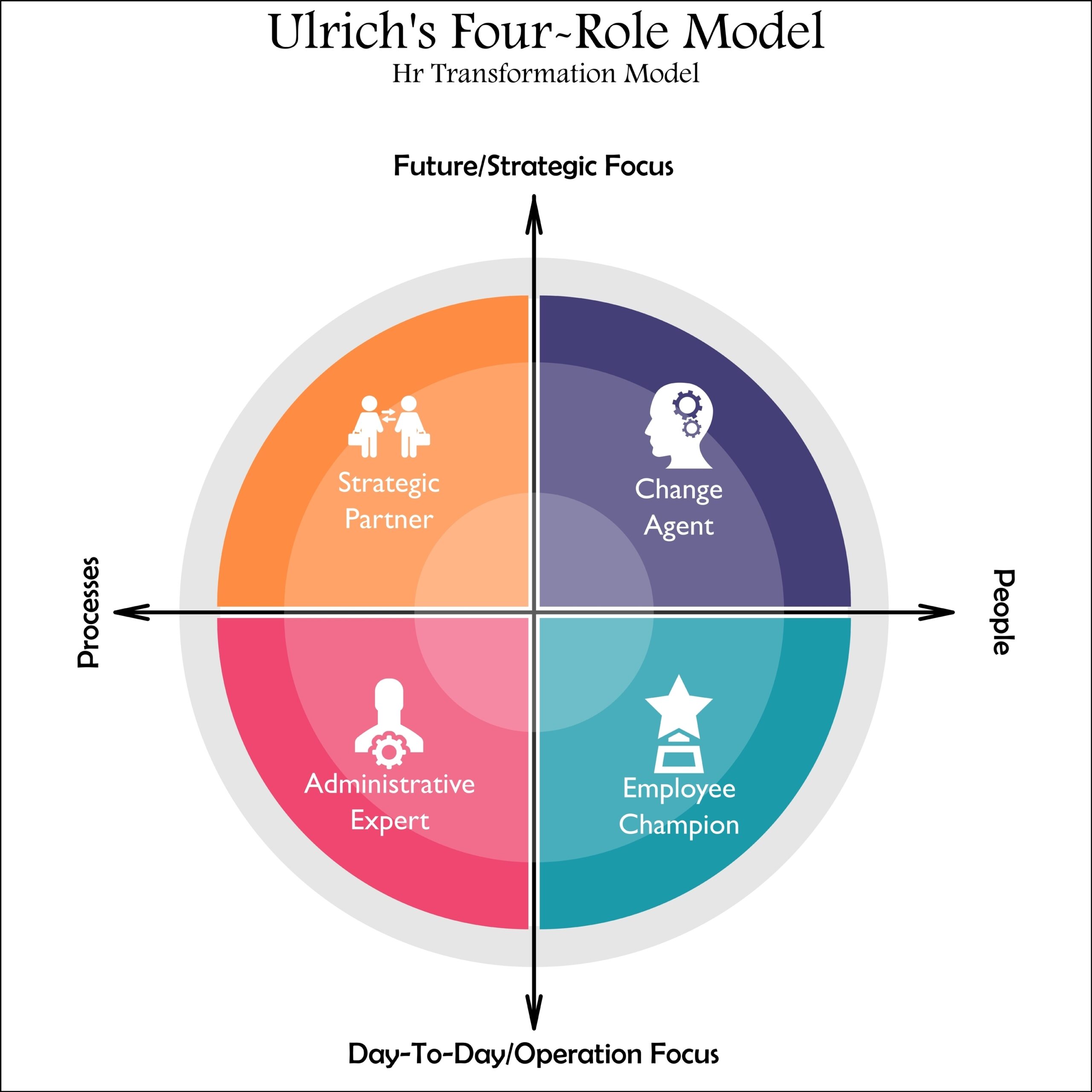
There are several HR models that can be implemented as part of an HR transformation, depending on the organisation’s specific needs and goals. The most common being the Ulrich HR model or iterations of this. Here are a few examples:

  • HR Business Partner Model: The HR Business Partner model is designed to align the HR function with the strategic goals of the business. In this model, HR professionals act as strategic advisors to business leaders, working closely with them to understand their needs and align HR strategies and practices with business objectives.
  • Shared Services Model: The Shared Services model involves centralising HR services and functions in a shared services centre. This can help organisations achieve greater efficiency, consistency, and cost savings in HR service delivery.
  • Centres of Excellence Model: The Centres of Excellence model involves creating specialised HR teams to support specific areas of HR, such as talent management, employee relations, or HR analytics. This model allows organisations to develop deep expertise in specific areas of HR and provide targeted support to the business.
  • Holistic HR Model: The Holistic HR model involves integrating HR practices with other key business functions, such as finance, operations, and marketing. This model recognises that HR is an integral part of the overall business strategy and seeks to align HR practices with other key functions to achieve a more integrated approach to business management.
  • Agile HR Model: The Agile HR model involves creating a more flexible and responsive HR function that can adapt quickly to changing business needs and market conditions. This model emphasises the importance of collaboration, experimentation, and continuous improvement in HR practices.
  • Digital HR Model: The Digital HR model involves leveraging technology to improve HR processes, enhance the employee experience, and provide better HR analytics and reporting capabilities. This model recognises the importance of technology in modern HR practices and seeks to leverage it to achieve greater efficiency, effectiveness, and innovation in HR service delivery.

What can go wrong during an HR transformation programme

Ulrich HR

Like any major organisational change initiative, HR transformation programs can encounter several challenges that may result in difficulties or failures. Here are a few examples of things that can go wrong during an HR transformation program:

  • Poor Change Management: HR transformation programs require significant changes to HR processes, systems, and organisational structures, which can be disruptive to employees. If change management is not handled effectively, employees may resist the changes, resulting in decreased engagement, productivity, and morale.
  • Lack of Executive Buy-In: Without strong executive buy-in and support, HR transformation programs may struggle to gain momentum and resources, resulting in delays or budget overruns.
  • Insufficient Planning: HR transformation programs require careful planning to ensure that the right HR processes, systems, and structures are put in place. Insufficient planning can lead to misaligned goals, unclear expectations, and inadequate resources.
  • Ineffective Communication: Clear and effective communication is critical for HR transformation programs to succeed. Without effective communication, employees may not understand the changes, leading to confusion, resistance, and reduced engagement.
  • Poor Vendor Selection: HR transformation programs often require the use of external vendors to implement new HR systems or processes. Poor vendor selection can result in delays, budget overruns, and inadequate solutions.
  • Lack of Flexibility: HR transformation programs require flexibility to adapt to changing business needs and market conditions. A lack of flexibility can result in outdated HR processes, systems, and structures that do not support the business.

Which consulting firms can help your HR transformation programme

There are many consulting firms that specialise in HR transformation and can help organisations plan, design, and implement their HR transformation programs. Here are a few examples:

  1. Deloitte: Deloitte offers a range of HR consulting services, including HR transformation, HR technology, HR operations, and talent management. They work with organisations to develop HR strategies and implement HR transformation programs that align with business goals.
  2. PwC: PwC offers HR consulting services that cover a range of areas, including HR transformation, talent management, HR technology, and workforce planning. They help organisations design and implement HR transformation programs that improve HR processes, enhance the employee experience, and support business objectives.
  3. Accenture: Accenture offers HR consulting services that focus on HR transformation, HR technology, talent management, and change management. They work with organisations to develop HR strategies and implement HR transformation programs that drive business growth and improve the employee experience.
  4. KPMG: KPMG offers HR consulting services that cover a range of areas, including HR transformation, talent management, HR technology, and organisational design. They help organisations develop HR strategies and implement HR transformation programs that support business objectives and improve HR service delivery.
  5. Mercer: Mercer offers HR consulting services that focus on HR transformation, talent management, HR analytics, and HR operations. They work with organisations to develop HR strategies and implement HR transformation programs that align with business goals and improve HR service delivery.

Which companies have successfully implemented an HR transformation programme

Many companies have successfully implemented HR transformation programs to improve their HR processes and better align HR with their business goals. Here are a few examples:

  • Unilever: Unilever, a global consumer goods company, implemented an HR transformation program to simplify and streamline its HR processes and better support the company’s growth strategy. The program involved the implementation of a new HR operating model, the consolidation of HR systems, and the creation of a new shared services centre.
  • IBM: IBM undertook a major HR transformation program to create a more agile and responsive HR function that could better support the company’s strategic goals. The program involved the implementation of a new HR service delivery model, the adoption of new HR technologies, and the creation of a new HR analytics function.
  • Procter & Gamble: Procter & Gamble implemented an HR transformation program to create a more customer-focused HR function that could better support the needs of the business. The program involved the implementation of a new HR service delivery model, the adoption of new HR technologies, and the creation of a new HR shared services organisation.
  • Nestle: Nestle implemented an HR transformation program to create a more standardised and efficient HR function across its global operations. The program involved the implementation of a new HR operating model, the adoption of new HR technologies, and the creation of a new HR shared services centre.

How can interim managers help an organisation during an HR transformation programme

Interim managers can play a valuable role in helping organisations during an HR transformation program. Here are a few ways they can assist:

  • Expertise: Interim managers are experienced professionals who bring a wealth of knowledge and expertise in HR transformation. They can help organisations navigate the complexities of the transformation program and provide guidance on best practices.
  • Flexibility: Interim managers can be brought in at any stage of the HR transformation program and can be hired for a specific period of time. This flexibility allows organisations to scale resources up or down as needed.
  • Objectivity: Interim managers provide an outside perspective and can help organisations identify areas for improvement or potential roadblocks. They can also provide an objective assessment of the program’s progress and offer recommendations for improvement.
  • Leadership: Interim managers can take on leadership roles within the HR transformation program, providing direction, guidance, and support to the team. They can help ensure that the program is aligned with the organisation’s overall goals and objectives.
  • Implementation: Interim managers can help organisations implement new HR processes, systems, and structures, ensuring that the program is completed on time and within budget.

What are the key HR transformation job roles and what are their responsibilities

There are several key job roles that play an important role in driving the HR transformation process. Here are some of the key roles and their responsibilities:

  • A HR Transformation Manager: Responsible for developing and implementing the strategy, overseeing the project team, and ensuring successful delivery of the HR transformation program.
  • HR Business Partner: Acts as a strategic advisor to business leaders and ensures alignment between HR initiatives and business goals.
  • An HR Process Analyst: Responsible for analysing existing HR processes and identifying opportunities for improvement and streamlining.
  • HR Data Analyst: Responsible for analysing HR data and providing insights to support decision-making related to talent management, workforce planning, and HR policies.
  • HR Technology Specialist: Responsible for identifying and implementing HR technology solutions that support the organisation’s HR strategy and business objectives.
  • Change Management Specialist: Responsible for managing the people-side of the HR transformation program, including communication, training, and change adoption.
  • HR Project Manager: Responsible for managing the HR transformation project, including scope, timeline, budget, and resources.
  • HR Communications Specialist: Responsible for developing and implementing internal communications strategies that support the HR transformation program and engage stakeholders.

Our Focus On Long-Term Partnerships

At re:find Executive Search we are specialists in HR transformation. We believe that recruitment is not a one-off transaction but rather a long-term partnership. By building long-term relationships with our clients, we help them to find and retain the best talent for their organisation.

Every organisation is unique and we feel that there is no one-size-fits-all solution when it comes to recruitment. re:find offer bespoke recruitment solutions, that are tailored to meet the specific needs of each client. Whether you need help with a single hire or a full recruitment campaign, we can help.

We commit to providing our clients with the highest quality service. We take the time to understand your organisation’s culture and values, as well as the specific skills needed for each campaign.

For more information please get in contact with our Managing Director, James Cumming.

Building Bridges: Innovative Solutions for Workplace Unity in Defence

Introduction

The defence industry, vital for national security, faces unique challenges in fostering cohesion and enhancing collaboration. These challenges, compounded by issues of gender representation and employee retention, warrant a closer examination to identify actionable improvements. This blog explores these issues and proposes solutions to ensure a more united and inclusive future in the defence sector.

Cohesion and Collaboration: Challenges and Solutions in the Defence Industry

The defence industry’s landscape is marked by varying levels of cohesion across different sectors.

For instance, the land systems sector exhibits a notable lack of collaboration. This often results in inefficiencies and a fragmented approach to project management and innovation. In contrast, the marine and submarine sectors demonstrate a more integrated approach. With entities actively communicating and supporting one another, particularly in redeployment scenarios.

To address these discrepancies, the industry could adopt some strategic approaches around its development of people.

Learning & Development:

  • Joint training programs. These should include personnel from different sectors of the defence industry can foster a sense of unity and understanding. These programmes can be designed to include team-building exercises. And cross-training on various technologies and operational tactics, which can build a more cohesive and adaptable workforce.
  • Inter-sector Mentorship Programs. Establishing mentorship programs that cross traditional sector boundaries within the defence industry can encourage the exchange of knowledge and experiences. Such programmes can pair up-and-coming professionals with seasoned experts in different fields. Promoting cross-pollination of ideas and strengthening the overall industry network.
  • Leadership Development Programs for Women: Create leadership development programs specifically tailored for women in the defence industry. These programs should focus on skill enhancement and leadership training. And providing networking opportunities that can help women advance to senior positions within their organisations.
  • Future-focused Training: Adapt training programs to not only meet current technological and strategic needs but also anticipate future developments. This approach ensures that the workforce remains capable and prepared to adopt modern technologies and methodologies swiftly.
  • Career Development Opportunities: Provide employees with clear career pathways and continuous learning opportunities. This could involve formal education programs and access to conferences and workshops. And, internal promotion opportunities that encourage employees to grow within the company.

Recruitment & Retention for the Defence Industry

  • Targeted Recruitment Campaigns: Focus on attracting more women into the industry through targeted recruitment campaigns that highlight the benefits and opportunities within the defence sector. These campaigns can include offering scholarships, creating internship opportunities, and forming partnerships with educational institutions that have strong female enrolments in relevant fields.
  • Retaining Talent: Strategies for a Robust Defence Workforce: Focus on developing a comprehensive strategy to retain the skilled and experienced workforce that is crucial for the defence industry’s success. This involves creating an attractive working environment and clear career progression paths.
  • Retention Strategies: Implement strategies aimed at improving retention rates, such as recognising and rewarding employee contributions, offering competitive benefits, and ensuring a supportive work environment that values and nurtures talent.
  • Competitive Compensation Packages: Ensure that compensation packages are competitive with the market to attract and retain top talent. This includes not only salaries but also benefits like health insurance, retirement plans, and performance bonuses.

Communication in the Defence Industry:

  • Standardisation of Communication Protocols: Implementing industry-wide standards for communication can help unify different sectors within the defence industry. By creating a common language and set of procedures for communication, organisations can reduce misunderstandings and delays, thereby enhancing operational efficiency and cooperation across various projects and teams.
  • Document Insights: LIOS: The Land Information Oriented Strategy (LIOS) document offers comprehensive recommendations that can guide the defence industry towards more streamlined and advanced practices. It emphasises the importance of integrating modern technologies and strategic approaches to meet current and future challenges.
  • Enhanced Data Sharing: Promote enhanced data sharing across organisations within the defence industry to avoid duplication of efforts and to streamline operations. This can involve developing secure, integrated platforms where information can be shared efficiently without compromising confidentiality or security.
  • Industry Stakeholders’ Engagement: Encourage industry stakeholders, including policymakers, private companies, and educational institutions, to take these recommendations seriously and collaborate on implementing them. This collective effort can significantly propel the industry forward with innovative and forward-thinking strategies.

Other Important Considerations

  • Improving Gender Representation: To address the current disparity in gender representation, the defence industry needs initiative-taking measures. With some companies only showing 21% female representation against a target of 30%, strategies such as awareness campaigns, dedicated recruitment drives, and highlighting role models are essential to inspire and attract more women to the industry.
  • Inclusive Workplace Policies: Develop workplace policies that cater to a diverse workforce by incorporating flexible working conditions, comprehensive maternity and paternity leave, and support for work-life balance. These policies should also address any unconscious biases and promote an inclusive culture that values all employees equally.
  • Work-Life Balance Initiatives: Introduce flexible working hours and remote work options where feasible to improve job satisfaction and accommodate the diverse needs of the workforce. These initiatives can help maintain a balanced and motivated workforce, which is essential for long-term retention and productivity.

Call to Action

Industry leaders, policymakers, and all stakeholders are encouraged to engage with these issues actively. By working together and embracing change, we can ensure a robust defence sector that is ready to face the challenges of tomorrow. The defence industry stands at a pivotal juncture, where fostering cohesion, enhancing gender representation, and retaining talent are not just beneficial but necessary for its sustained success and relevance. By embracing these challenges as opportunities for growth and transformation, the industry can look forward to a more integrated, inclusive, and innovative future.

OUR FOCUS ON LONG-TERM PARTNERSHIPS

At re:find we have been in Executive Search for over 20 years. We believe that recruitment is not a one-off transaction but rather a long-term partnership. We aim to build long-term relationships with our clients, providing ongoing support and advice to help them find and retain the best talent for their organisation.

In addition, as a business, we understand that every organisation is unique and that there is no one-size-fits-all solution when it comes to recruitment. That’s why we offer bespoke recruitment solutions that are tailored to meet the specific needs of each client. Whether you need help with a single hire or a full recruitment campaign, we can help.

We are committed to providing our clients with the highest quality service. As part of this, we ensure that we take the time to understand your organisation’s culture and values, as well as the specific skills and experience needed for each role.

For more information on our executive search practice and our CCS framework
please get in touch with our Managing Director, James Cumming.

Please visit our website to see more of our knowledge hub: https://refind.co.uk/